

Recently, Prof. Peng Xue’s team at Southeast University has made important progress in the experimental study of quantum causality and indefinite causal order. Using entangled photons and a photonic quantum switch, the team constructed an experimental scenario incorporating spacelike-separated measurements and observed a significant violation of a Bell-like causal inequality by 24 standard deviations. The results were published on August 7, 2026, in Science Advances under the title “Experimental violation of a Bell-like causal inequality in a photonic quantum switch.”
Indefinite causal order is a distinctive quantum causal structure in which different orders of quantum operations can exist in a coherent superposition. The quantum switch is a paradigmatic realization of indefinite causal order. Previous experimental demonstrations, however, have generally relied on specific descriptions or models of the experimental devices. In contrast, a device-independent approach seeks to infer causal structure solely from the observed input-output correlations, thereby reducing reliance on assumptions about the internal operation of the devices. A major challenge is that the standard quantum switch itself cannot violate conventional causal inequalities. The recently proposed VBC protocol introduces a spacelike-separated observer and provides a new route to testing indefinite causal order in a quantum switch through a Bell-like causal inequality.
To implement this protocol, the research team constructed a photonic quantum switch using a high-quality polarization-entangled photon pair, involving four parties: Alice 1, Alice 2, Bob, and Charlie. In the experiment, Bob and Charlie were located approximately 20 meters apart. Their measurement settings were independently generated by random number generators and rapidly switched using electro-optic modulators, ensuring that the relevant measurement events satisfied the required spacelike-separation condition. The team then measured the complete conditional probability distributions for different input settings. The experimentally obtained value of the Bell-like causal inequality was 1.8090 ± 0.0024, exceeding the bound of 1.75 allowed by models with definite causal order by 24 standard deviations.
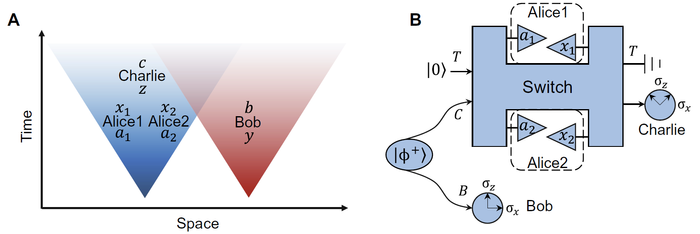
Figure: Schematic spacetime configuration of the measurement events in the photonic quantum-switch experiment
This work realizes several key experimental ingredients required for a device-independent test of indefinite causal order. Under the fair-sampling assumption and the spacetime conditions implemented in the experiment, the results provide experimental evidence against hidden-variable models with fixed causal order. The significant violation of the Bell-like causal inequality provides further experimental support for indefinite causal order and lays the groundwork for future fully loophole-free device-independent verification of indefinite causal order.
The first author of the paper is Associate Professor Dengke Qu from Southeast University, and the corresponding author is Professor Peng Xue from Southeast University. The collaborators also include postdoctoral researcher Quan Lin, Professor Lei Xiao, and Professor Xiang Zhan, all from Southeast University. This work was supported by the National Key R&D Program of China, the National Natural Science Foundation of China, the China Postdoctoral Science Foundation, the Basic Research Program of Jiangsu Province, and the Beijing National Laboratory for Condensed Matter Physics.
Paper link:https://www.science.org/doi/full/10.1126/sciadv.aee9271
