

Dr. Jue Hou, Associate Professor Jie Gu, and Professor Yunfeng Jiang from the Shing-Tung Yau Center and the School of Physics at Southeast University have made new progress in the study of TTbar deformations of two-dimensional conformal field theory. Their research was published on August 21, 2026, as a Letter entitled “Beyond Hagedorn: A Harmonic Approach to TTbar Deformation” in the internationally renowned physics journal Physical Review Letters.
TTbar deformation is a class of solvable deformations of two-dimensional quantum field theories with many distinctive properties, and it has attracted considerable attention from the international research community in recent years. On the one hand, unlike conventional local quantum field theories, TTbar-deformed theories exhibit nonlocality in the high-energy regime, and their thermal partition functions possess a Hagedorn singularity. These features resemble those found in quantum gravity and string theory, providing a new perspective for the study of quantum gravity. On the other hand, the deformation is solvable, and many important physical quantities can still be computed exactly after the deformation, facilitating in-depth theoretical analysis.
The partition function is a fundamental quantity in quantum field theory and plays a crucial role in studying the thermodynamic properties of a theory and holographic duality. In two-dimensional conformal field theory, the thermal partition function can be naturally generalized to the torus partition function, which is both analytically tractable and endowed with the important property of modular invariance. After applying a TTbar deformation to a conformal field theory, a key question is how to compute its thermal partition function exactly and uncover its new properties. Previous studies were limited to perturbative expansions of the deformed partition function and were unable to obtain the complete result including all nonperturbative contributions.
Through close collaboration, Dr. Jue Hou, Associate Professor Jie Gu, and Professor Yunfeng Jiang developed a new method based on harmonic analysis, achieving for the first time a complete nonperturbative computation of the deformed partition function. The method rests on two key observations. First, TTbar deformation preserves modular invariance, allowing the partition function to be expanded in a set of basis functions with the same property, known as Maass modular forms. This expansion is analogous to the Fourier expansion of a periodic function. Second, one can prove that these basis functions exhibit remarkably simple transformation behavior under TTbar deformation. Consequently, the deformed torus partition function can be expanded in the same basis, with the expansion coefficients determined using efficient numerical algorithms.
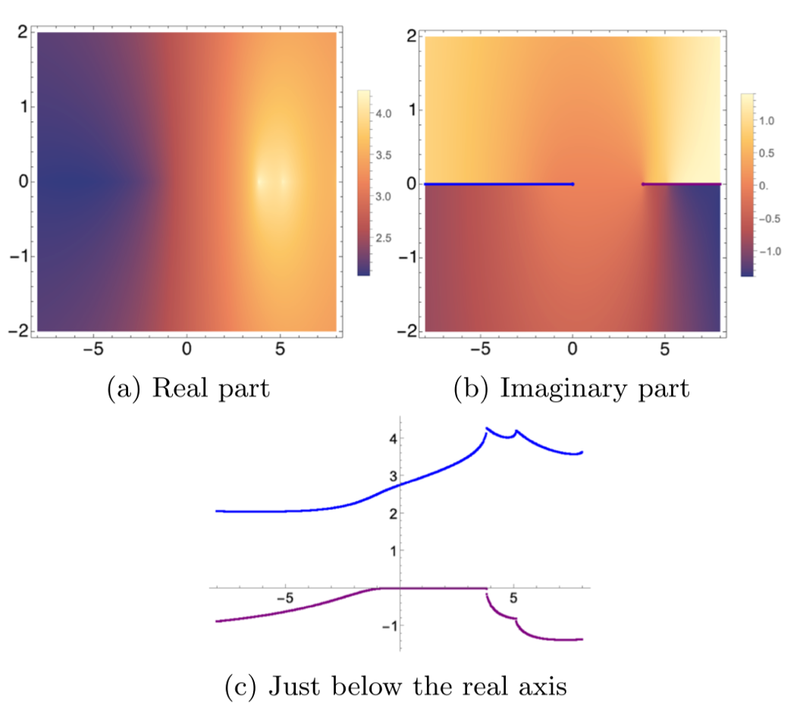
Using this method, the research team obtained, for the first time, nonperturbative numerical results for the torus partition function of a TTbar-deformed conformal field theory. At the same time, the harmonic-analysis approach provides a new avenue for investigating the analytic properties of the deformed partition function. For example, through a new analytic treatment, the researchers confirmed from a different perspective the presence of a Hagedorn singularity in the partition function.They further found that the partition function can be analytically continued beyond the Hagedorn singularity, yielding finite results even in the high-energy regime beyond this singularity. This work provides a new theoretical tool for the study of TTbar-deformed quantum field theories and deepens our understanding of their behavior in the high-energy regime.
Following the convention in the high-energy physics community, the authors of the paper are listed alphabetically by surname. This research was supported by the National Natural Science Foundation of China through the Excellent Young Scientists Fund Program (Overseas) and the General Program.
Paper Link:https://journals.aps.org/prl/abstract/10.1103/kcs1-7q6n
