

A collaborative research team led by Professor ZhenhuaNi, Professor JialinZhang, and Associate Professor DongyangWan from Southeast University has recently made significant progress in high-performance uncooled mid-wavelength infrared (MWIR) photodetection. Their work, titled “Van der Waals/MCT heterostructure enabled high-performance uncooled mid-infrared photodetectors via synergistic suppression of dark current and interfacial recombination” is published in Light: Science and Applications.
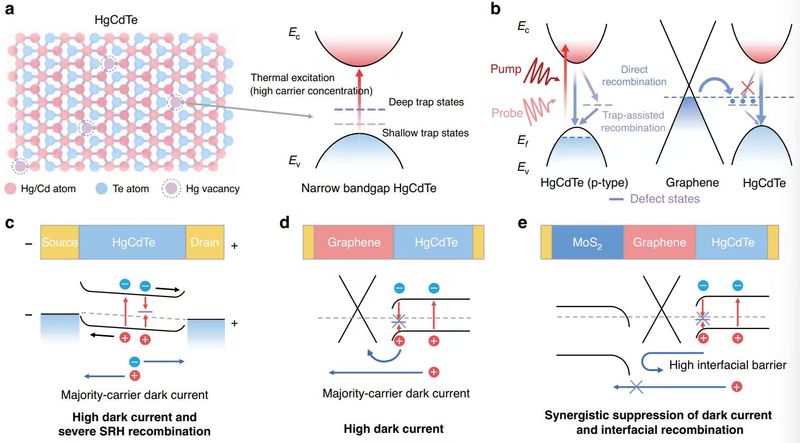
MWIR photodetection is crucial for applications such as night vision, remote sensing, spectral imaging and optical communication, yet its room-temperature operation faces a fundamental challenge of excessive dark current. While high-operating-temperature MCT devices mitigate this issue through band structure engineering, their practical implementation is hindered by the intricate multilayer heteroepitaxy and lattice-mismatch-induced interfacial defects.The interfacial defects act as recombination centers, accelerating defect-assisted recombination and elevating dark current. These limitations highlight the urgent need for novel device architectures that simultaneously mitigate dark current and interfacial defects while maintaining fabrication simplicity.
To tackle this issue, the teamdeveloped anuncooled high-performance MWIR photodetector based on vdW/MCT heterostructure via synergistic suppress dark current and interfacial recombination. Specifically, the vdW/MCT heterostructure architectureis realized in a MoS2/graphene/MCT configuration, where MCT layer serves as the primary infrared absorber.The high interfacial barrier and built-in electric field at the MoS2/MCT interface block the transport of thermal excited majority carriers. The interlayer graphene suppressesinterfacial recombination via charge transfer and enhances photoelectric conversion. Through rational interfacialband alignment engineering, their device enables high-sensitivity broadband photodetection spanning the visible, near-infrared, and mid-wavelength infrared spectral regions at room temperaturewith excellent linearityand high photoresponse speed of ~23 ns. More importantly, the device achieves an impressive specific detectivity of 8.0 × 1010 cm Hz1/2 W–1 under blackbody radiation, outperforming state-of-the-art uncooled MWIR photodetectors.The reported architectureprovides a feasible strategy for designing high-performance uncooled MCT-based infrared photodetector via 2D/MCT heterogeneousintegration.
The co-first authors are doctoral students XinleiZhang and TaoZhou from the School of Physics. The corresponding authors are Professor ZhenhuaNi (School of Electronic Science and Engineering), Professor JialinZhang (School of Physics), and Associate Professor DongyangWan (School of Physics). This research was supported by the National Key Research and Development Program of China, the National Natural Science Foundation of China, the Major Science and Technology Special Project of Jiangsu Province, the Natural Science Foundation of Jiangsu Province, and the Start up Research Fund of Southeast University.
Paper link:https://www.nature.com/articles/s41377-026-02418-y
