

Recently, Professor Shuai Dong and Associate Professor Jun-Jie Zhang research team at the School of Physics, Southeast University reported new progress in the physics and applications of autferroic materials. The work, entitled “Autferroics-Based True Random Number Generators with Enhanced Performance” was published in Physical Review Letters.
Multiferroics, which combine magnetism and ferroelectricity, shows great promise for applications in information storage, sensing, and low-power devices. However, the intrinsic competition between these two orders in terms of symmetry and microscopic mechanisms has long hindered the realization of strong magnetoelectric coupling. To address this challenge, Prof. Shuai Dong’s team previously proposed the concept of “alterferroicity” or “autferroicity” [PNAS 120, e2305197120 (2023)], in which magnetic and ferroelectric states are stabilized in different phases of the same system and exhibit a seesaw-like mutual exclusion, thereby enabling strong magnetoelectric coupling. The team subsequently developed a Landau theoretical framework for autferroicity, providing a unified description of single-ferroic, multiferroic, and autferroic states and revealing the conditions for the emergence of autferroicity and the underlying mechanism of its strong magnetoelectric coupling [Phys. Rev. Lett. 134, 216801 (2025)].
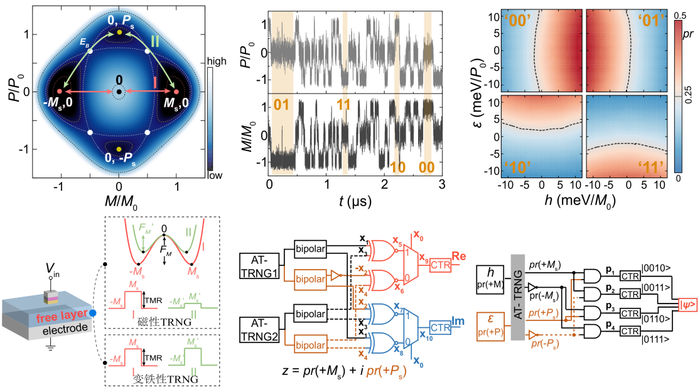
Building on the seesaw-like magnetoelectric coupling in autferroic systems, the research team explored their application in true random number generators (TRNGs). Conventional magnetic TRNGs typically increase thermally driven switching rates by lowering the switching barrier, but this often comes at the expense of state stability and electrical readout fidelity. The team found that magnetoelectric coupling in autferroics can reshape the energy landscape and effectively reduce the switching barriers between ferroic states while maintaining a high electrical readout contrast, thereby enhancing TRNG performance. In addition, autferroic TRNGs can be extended to quaternary random encoding and further applied to probabilistic logic computing, providing new physical degrees of freedom for stochastic information processing and potentially reducing the number of devices and logic units required in certain stochastic computing circuits.
The first author is Associate Professor Jun-Jie Zhang from the School of Physics. The corresponding authors are Professor Shuai Dong (School of Physics) and Professor Boris Yakobson (Rice University). This research was supported by the National Key Research and Development Program of China, the National Natural Science Foundation of China, and Southeast UniversityInterdisciplinary Research Program for Young Scholars.
Paper link:https://doi.org/10.1103/8vd7-ffng
