

Recently, Professor Qiyun Tang’s group at Southeast University proposed a new theory for the mechanism of biomolecular liquid-liquid phase separation (LLPS). The work, published in the Journal of the American Chemical Society (JACS) as “Negative Interfacial Tension Driven by Intrinsic Molecular Disorder”, shows that the attraction between a conserved density field and a nonconserved junction field, together with fluctuations in the junction field, renormalizes the effective interfacial tension to negative values. This negative interfacial tension suppresses coalescence and stabilizes a scale-invariant ensemble of clusters with a power-law size distribution, as confirmed by numerical calculations and coarse-grained simulations of sequence-disordered biomolecules and consistent with diverse experimental observations.
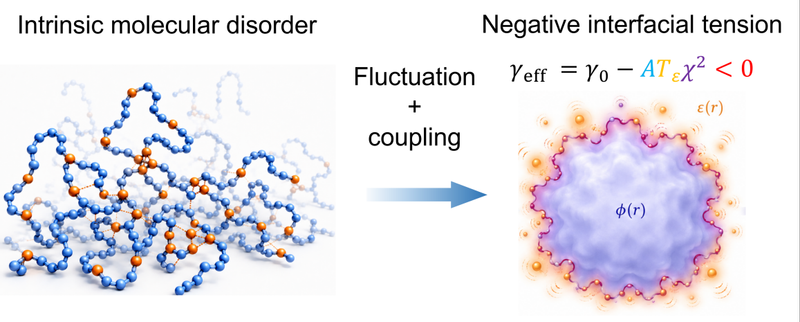
In classical polymer physics, sequence regularity often leads to predictable phase behavior: block copolymers form well-defined microphase-separated domains, and homopolymers undergo macroscopic LLPS as described by Flory-Huggins theory. For intrinsically disordered molecular systems, such as random copolymers and intrinsically disordered proteins, however, experiments reveal a strikingly different phenomenon: rather than coarsening into a few large droplets, the system self-organizes into stable, polydisperse clusters with scale-invariant, power-law distributions. This behavior is widely observed in biomolecular condensates such as nucleoli, FUS protein condensates, and huntingtin aggregates, and differs markedly from the narrow Lifshitz-Slyozov-Wagner distribution predicted by Ostwald ripening, as well as from near-critical Ising scaling. A central challenge is to understand how sequence randomness, which cannot be averaged into effective parameters, drives LLPS and to establish a general physicochemical mechanism.
To address this problem, Tang and co-workers constructed a minimal coupled field theory in which a conserved density field describes local concentration fluctuations of biomolecules and a nonconserved junction field represents the stochastic binding-site density associated with dynamic cross-linking. Using statistical field theory, they showed that the coupling and junction-field fluctuations jointly drive negative interfacial tension. Numerical integration of the coupled dynamical equations and coarse-grained molecular dynamics simulations of sequence-disordered biomolecules confirmed the mechanism. The results provide a unified theoretical framework for understanding phase separation in disordered systems such as biomolecular condensates and random copolymers, and suggest new opportunities for engineering heterogeneous soft matter and synthetic biological systems.
The first authors are Chuan Tang and Yifan Huang, doctoral students at the School of Physics, Southeast University. The corresponding authors are Professor Qiyun Tang of Southeast University and Prof. Yu-Qiang Ma of Nanjing University. This work was supported by the National Natural Science Foundation of China, the Fundamental and Interdisciplinary Disciplines Breakthrough Plan of the Ministry of Education of China, the Natural Science Foundation of Jiangsu Province, and other funding sources.
Paper link: https://doi.org/10.1021/jacs.6c10169
