

On 22 October 2026, Prof. Peng Xue's group at Southeast University reported important progress in the experimental study of quantum thermalization dynamics: they observed the genuine quantum strong Mpemba effect in the minimal quantum system — a single qubit — and revealed the key role of quantum coherence in this anomalous thermal relaxation. The work was published in Physical Review Lettersunder the title "Genuine Quantum Strong Mpemba Effect by Eliminating Coherence".
During thermalization, a system initially farther from equilibrium can, under certain conditions, reach equilibrium faster than one initially closer — a counterintuitive phenomenon known as the Mpemba effect, whose origin can be traced back to Aristotle's observation more than two thousand years ago that initially hot water freezes faster. The strong Mpemba effect offers the conceptually most transparent mechanism for understanding this phenomenon: the relaxation toward equilibrium can be exponentially accelerated when the initial state has vanishing overlap with the slowest decay mode of the dynamics. However, realizing the strong Mpemba effect typically requires the slowest decay mode to be unique, whereas in quantum systems the slowest decay modes are often degenerate — a fundamental challenge to realizing the strong Mpemba effect in the quantum regime.
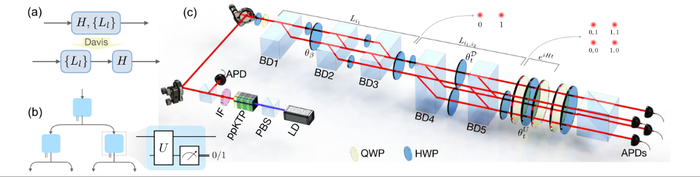
Figure 1: Decomposition of the Davies map and the experimental scheme of the photonic quantum simulation.
To meet this challenge, this work designed and constructed a fully controllable linear-optical quantum simulation platform and successfully realized the thermalization dynamics governed by the Davies map. The qubit is encoded in the polarization of a single photon, the ancilla qubits in the path modes of the photon, and key parameters such as the inverse temperature and the evolution time are directly encoded into the setting angles of wave plates, avoiding the need in conventional quantum simulations to recalculate the evolution and reconfigure the optical circuit at each time step. By explicitly verifying the semigroup property of the dynamics as well as the commutation structure between the unitary and dissipative parts, the experiment confirmed that the realized evolution forms a genuine quantum Markov semigroup, faithfully simulating the Davies map.
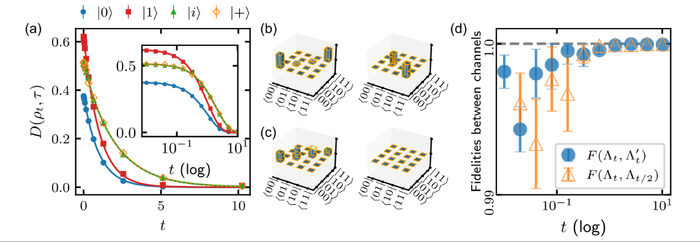
Figure 2: Experimental results of the thermalization dynamics.
Based on this platform, the research team first verified the simulated thermalization dynamics through quantum state tomography and quantum process tomography: for arbitrary initial states, the distance between the system and the thermal equilibrium state decays monotonically to zero with time, and the realized dynamics satisfies the semigroup structure. On this basis, exploiting the unique property of the Davies map — its degenerate slowest decay modes are purely coherent in the energy eigenbasis — the team eliminated the coherence from the initial state so that its overlap with the slowest decay modes vanishes, thereby experimentally observing the genuine quantum strong Mpemba effect in the minimal quantum system, a single qubit: the state with a higher initial nonequilibrium free energy approaches thermal equilibrium faster during the evolution, and the ordering of the free energies is reversed. Further analysis shows that the observed Mpemba effect cannot be explained by classical populations alone, and that quantum coherence plays a dual role: eliminating coherence induces faster relaxation, while coherence is also the source of the nonequilibrium free energy beyond classical populations.
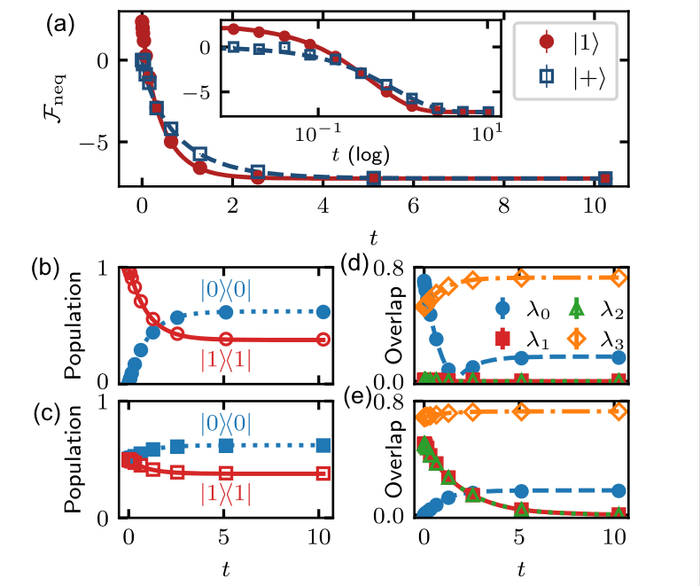
Figure 3: Experimental observation of the genuine quantum strong Mpemba effect.
This work realizes, for the first time, the genuine quantum strong Mpemba effect in the minimal quantum system, and confirms from two aspects — eliminating coherence induces accelerated relaxation, and coherence carries nonequilibrium free energy — that quantum coherence is the key resource of this anomalous thermal relaxation. The modular decomposition scheme developed in the experiment can realize arbitrary trace-preserving quantum channels on linear-optical platforms, providing a versatile quantum-optical platform for exploring quantum thermodynamics and broader open-system dynamics (such as Mpemba-effect-assisted quantum thermal machines).
All authors of this paper are from the School of Physics, Southeast University. The authors are Xiang Zhan, Huixia Gao, Lei Xiao, and Peng Xue from Prof. Peng Xue's group. Prof. Xiang Zhan is the first author, and Prof. Peng Xue is the corresponding author. This work was supported by the National Key R&D Program of China, the National Natural Science Foundation of China, and other programs.
Article link: DOI: https://doi.org/10.1103/z9t9-mwgv
