

Recently, Professor Ling-Fang Lin at Southeast University proposed a new theory for the mechanism for understanding the physics of altermagnetism. The work, entitled “Altermagnetism in Folded Iron Chain Systems” have been published in the prestigious physics journal Physical Review Letters.
Altermagnetism is an emerging form of magnetism that exhibits momentum-dependent spin splitting despite having zero net magnetization. To date, most studies of altermagnetism have focused on systems with Néel-type antiferromagnetic order. As research in this field advances, an important question arises: Can altermagnetism emerge in systems with block-type magnetic order? If so, what symmetry conditions and microscopic mechanisms are required, what unusual electronic and transport properties might arise, and can such altermagnetism be realized in actual materials?
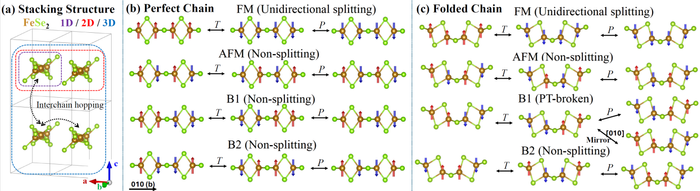
Based on themechanismof “half-half” antiferromagnetism and “half-full” ferromagnetismproposed by Professor Lin [Phys. Rev. Lett.127, 077204 (2021)], they investigated one-dimensional chains of FeSe₄ tetrahedra with block-type magnetic order (↑↑↓↓), exploring the conditions for stabilizing altermagnetism and systematically analyzing the underlying symmetry requirements and physical mechanisms.
They established a rigorous no-go theorem for altermagnetism in strictly one-dimensional systems, demonstrating that electronic bands remain spin-degenerate even when combined parity-time reversal PT symmetry is broken, due to a residual symmetry constraint. They further demonstrated that finite inter-chain electronic hopping can overcome this constraint through dimensional crossover from one-dimensional to quasi-one-dimensional systems, resulting in the d-wave altermagnetism without requiring fourfold rotational symmetry in folded iron-chain systems with block-type magnetic order. Moreover, the reduced crystal symmetry allows for unconventional Fermi-surface structures and nonlinear spin responses.
Regarding potential material realizations, the team identified K₃Fe₂Se₄ and related compounds, which feature quasi-one-dimensional iron–selenium chains, as promising candidates for realizing the proposed altermagnetic mechanism. Notably, Research Professor Ling-Fang Lin and her experimental collaborators also recently confirmed the presence of block-type magnetic order in K₃Fe₂Se₄ through neutron-scattering experiments [Phys. Rev. Lett.136, 256706 (2025)].
These findings not only deepen our understanding of the microscopic mechanisms and symmetry requirements underlying altermagnetism in low-dimensional systems but also broaden the material platforms and physical scenarios for realizing altermagnetism. Furthermore, they provide new directions for exploring novel altermagnetic materials, unconventional electronic states, and potential applications in spintronics.
The first authoris Professor Ling-Fang Lin of Southeast University. The corresponding authors are Dr. Yang Zhang of the University of Tennesseeat Knoxville and Prof. Lun-Hui Hu of Zhejiang University.
Paper link: https://doi.org/10.1103/6327-7256
